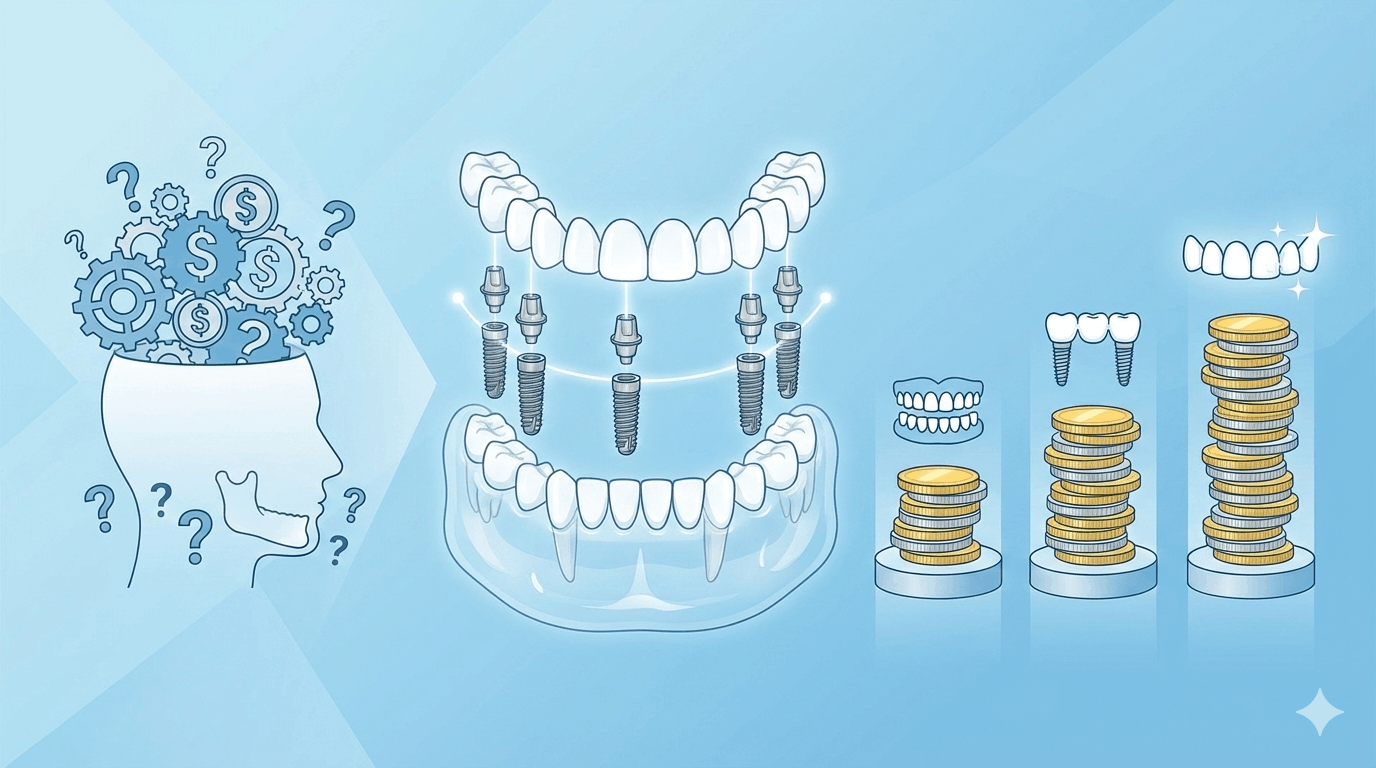
If you have started researching how much does a full set of dental implants cost, you have likely realized that finding a straight answer is like trying to pin down a moving target. You see advertisements for "cheap" implants that sound like a bargain, only to walk into a consultation and be handed a treatment plan that rivals the price of a mid-sized SUV.
For the average American patient aged 45 to 65, the sticker shock is often the biggest barrier to care. You are not just buying a dental procedure; you are making a major financial decision for your long-term health. According to industry data and financial benchmarks, a full-mouth restoration in the U.S. typically sits between $30,000 and $60,000 per arch.
But here is the insider reality: the "average" price is rarely what you actually pay. Between insurance limitations, hidden surgical fees, and the critical role of financing, the final number on your bill depends entirely on how you navigate the system.
THE BREAKDOWN: What Goes Into a Full-Arch Price Tag?
To understand the full cost, we have to deconstruct the "all-in" quote. A "full set" usually refers to a fixed bridge supported by four to six implants (commonly called All-on-4 or All-on-6). You aren't paying for 32 individual screws; you are paying for a complex engineering project in your jaw.
1. The Pre-Surgical Prep
Before the first implant is even placed, you may incur costs for:
- CBCT 3D Scans: These typically range from $350 to $1,000. They are non-negotiable for safe placement.
- Extractions: If you have remaining failing teeth, expect to pay $75 to $650 per tooth.
- Bone Grafting: This is the "hidden" cost that most often catches patients off guard. If your jawbone has atrophied, a graft can cost anywhere from $200 to over $3,000 for complex reconstructions.
2. The Implant Hardware
You are paying for the "post" (the screw), the "abutment" (the connector), and the "prosthesis" (the teeth). Premium manufacturers like Straumann or Nobel Biocare invest heavily in research, which is why their hardware costs more than "generic" brands.
3. The Anesthesia Factor
For full-arch procedures, most patients prefer IV sedation. This can add $500 to $2,000 to the total bill, depending on the length of the surgery.
💡 Pro Tip: When comparing quotes, always ask if the price is "Restored." Some clinics quote the "Surgical Phase" only (the screws), leaving you to discover later that the actual teeth cost an additional $15,000.
2026 Price Guide: Market Tiers
| Market Tier | Typical Cost Range (USD) | What This Usually Includes |
| Low | $28,000 – $35,000 | Acrylic/hybrid teeth, generic brands, limited warranties. |
| Average | $38,000 – $50,000 | Zirconia options, major brands (Nobel), experienced labs. |
| High | $55,000 – $65,000+ | Premium Zirconia, master technicians, lifetime guarantees. |
The Insurance & Financing Reality Check
Most dental PPO plans have an annual maximum of $1,500–$2,000. While insurance might cover a crown or an extraction, it rarely covers the implant post or surgical labor. To bridge the gap, smart patients use:
- Third-Party Financing: Companies like Care Credit or Proceed Finance allow you to break a $40,000 bill into monthly payments over 24 to 60 months.
- HSA and FSA Funds: Using pre-tax dollars can save you up to 30% on the total cost. If you schedule surgery in December and restoration in January, you can sometimes utilize two years' worth of contributions.
- HELOC or Personal Loans: Home equity or specialized medical loans often offer lower interest rates than traditional credit cards.
💡 Pro Tip: Many premium offices offer a "Cash Discount" (usually 5–7%) if you pay upfront. Always ask for the "Pre-pay discount" to shave thousands off the total.
STRATEGIC ALTERNATIVES: How Smart Patients Save
1. The Power of "Domestic Arbitrage"
A specialist in Beverly Hills or Manhattan has overhead costs that a surgeon in Dallas or Salt Lake City does not. It is common for patients to save $15,000 by flying to a "High-Volume Implant Center" in a lower-cost state.
2. Specialist over Generalist
It sounds counterintuitive, but seeing a specialist (Oral Surgeon or Periodontist) often saves money long-term. According to the AAOMS, specialists are better equipped to handle bone grafting. A "cheap" implant placed by an inexperienced generalist that fails after two years will cost you double to fix.
3. All-Inclusive "Flat Fee" Pricing
Avoid clinics that bill "unbundled" services. Look for centers that offer a single, all-inclusive price that covers everything from the 3D scan to the final Zirconia bridge. This protects you from "cost creep."
CONCLUSION
When evaluating how much does a full set of dental implants cost, remember that the highest cost is the surgery you have to do twice.
Value isn’t just a number—it’s the intersection of surgical skill, material quality, and a payment plan that doesn't compromise your financial future. By leveraging domestic arbitrage and maximizing pre-tax accounts, you can access the gold standard of care.
Don’t guess with your health or your wallet.