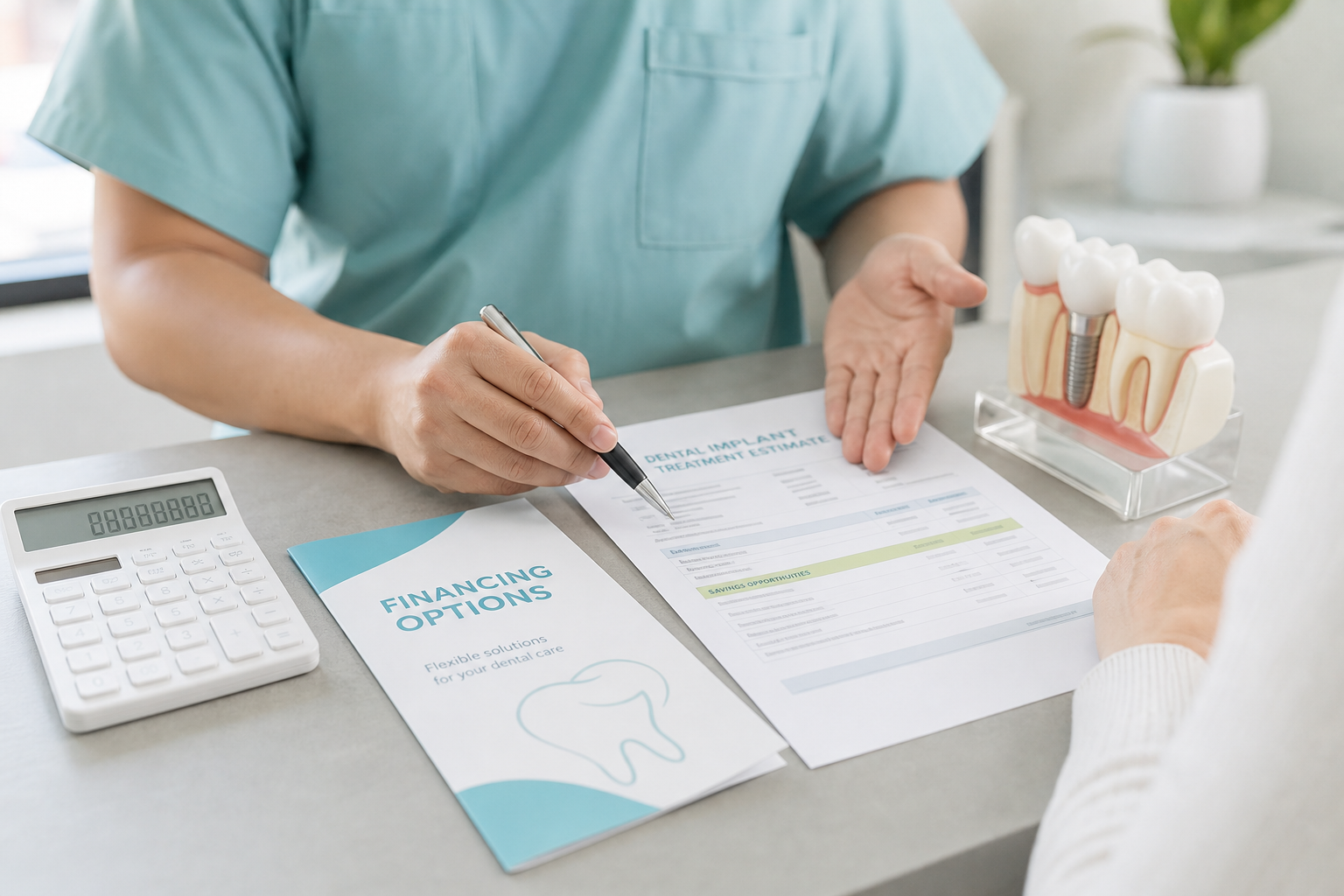
You searched low cost dental implants because you need the bill to fit your household—not because you want whoever posts the lowest number online.
That distinction matters. Implant treatment is surgery plus restorative dentistry spread over months. Saving smart means using phased planning, verified insurance, fair quote comparison, vetted dental-school options, and careful financing—not accepting an incomplete quote or unverified provider because the headline price feels like relief.
This how-to guide walks through legitimate cost-reduction levers for US patients in 2026—and the discount traps that can cost more later. It is not medical advice, insurance advice, tax advice, or a promise of coverage, savings, or financing approval. Verify clinical suitability with a qualified dental professional before any treatment decision.
Save Smart vs Save Unsafe
| Save smart | Save unsafe |
| Itemized quotes compared on the same finish line | Post-only price treated as a complete tooth |
| Insurance verified by procedure code before scheduling | "We take your insurance" without a benefit estimate |
| Phased payments aligned to confirmed treatment steps | Large deposit before imaging reveals grafting needs |
| Dental school care chosen with eyes open on timeline | Travel or "special" pricing with no follow-up plan |
| Financing used for confirmed gaps after verification | Promotional monthly payment mistaken for a lower total fee |
The rest of this article focuses on the left column—practical moves that can reduce out-of-pocket cost without gambling on the right column.
Why the Lowest Headline Is Usually Incomplete
The American Dental Association's MouthHealthy implant guide describes implants as posts placed in the jaw to anchor replacement teeth, with healing before final restorations.
Mayo Clinic's dental implant surgery overview notes treatment may involve exams, imaging, extractions, bone grafting, implant placement, abutment placement, and the artificial tooth. Revision cases can be more complex when earlier treatment cut corners.
Low ads often quote one slice of that path:
- Implant post only — not the abutment or crown you chew with.
- Surgery without imaging, temporaries, or follow-ups — add-ons appear after CBCT.
- One arch in a "full mouth" promo — both arches and premium materials priced separately.
- Monthly payment marketing — cash flow looks smaller than total treatment cost.
Before any strategy below helps, define your finish line: post placed only, temporary during healing, or final crown/bridge/arch delivered—with grafting and sedation listed as conditional add-ons, not surprises.
Six Legitimate Ways to Lower Out-of-Pocket Implant Cost
None of these guarantees a lower total for your case. Each can reduce what you pay at the counter, spread payments safely, or surface fair pricing—when verified.
1. Phased Treatment and Cash-Flow Planning
Implant care naturally arrives in phases: diagnostics, surgery, healing, then final restoration. Paying phase by phase does not automatically shrink the total fee unless scope or materials change—but it can prevent you from borrowing for work imaging has not confirmed yet.
Pro tip: Ask which fees are due before surgery, after integration is confirmed, and at final crown delivery. A low deposit is not a complete budget.
Questions for the coordinator:
- Which line items are billed separately if grafting is needed after CBCT?
- Can restorative work wait until healing is confirmed?
- What financial policy applies if surgery reveals a different plan?
Phased planning protects cash flow. It is not a substitute for itemized pricing.
2. Verify Dental Implant Insurance Before You Schedule
Dental implant insurance may pay toward some line items—extractions, imaging, crown portions—while excluding the implant body or capping payment at an annual maximum.
Humana's implant coverage overview notes implant bills can include consults, X-rays, grafts, anesthesia, and crowns. Waiting periods for major services may delay benefits on newer plans.
Three-step verification playbook:
- Get codes — Ask the clinic for an itemized plan with procedure codes, providers, and timing by phase.
- Call the insurer — Use this script:
I am considering dental implant treatment and have an itemized plan. Can you review each procedure code and tell me what is covered, excluded, subject to waiting periods, and how much of my annual maximum remains today?
- Budget the gap — Plan patient responsibility as if insurance pays less than the front desk hopes. Partial coverage can legitimately lower out-of-pocket cost without changing the clinic's base quote.
A clinic that "accepts your insurance" is not the same as a clinic that confirmed what your plan will pay for surgery, grafting, or the final crown.
3. Compare Two or Three Itemized Dental Implant Quotes
The most reliable way to stop overpaying is often transparent comparison in your market—not a mystery discount.
Run each dental implant quote through the same checklist:
- Same finish line — post-only vs complete tooth or arch delivered.
- Same conditional language — how each quote handles "if grafting is needed."
- Same timing — when temporaries and final teeth are placed and paid for.
- Same warranty terms — what happens if an implant does not integrate.
- Same team clarity — who places implants vs who delivers final restorations.
If an office cannot itemize the estimate, treat the total as incomplete—not automatically dishonest, but not ready to anchor your budget.
For arch-level transparency and tier traps, read Full Mouth Dental Implants Cost: An Insider Guide for Patients Who Don't Want to Overpay.
4. Explore Dental School and Teaching Clinics Carefully
University dental schools and advanced residency programs sometimes offer implant-related care at lower professional fees than private specialty offices. The NIH National Institute of Dental and Craniofacial Research explains that dental school clinics may provide treatment at reduced cost, with students supervised by faculty—often with longer appointment blocks.
How to evaluate a dental school option:
- Confirm the program treats your scope (single tooth, bridge, full arch—not all programs do).
- Ask total timeline from consult to final teeth vs your private quote.
- Ask who performs surgery and restorative phases under supervision.
- Ask what happens if complications arise after you return home.
- Compare complete itemized totals, not just the surgical fee.
Dental school care can be a legitimate savings path for some patients. It is not automatically faster, closer, or appropriate for every case.
5. Use HSA, FSA, and Financing for Confirmed Gaps Only
Pre-tax accounts and payment plans do not reduce the clinic's treatment price. They help you manage verified out-of-pocket gaps after insurance review.
The IRS medical and dental expense publication includes dental treatment for prevention or alleviation of dental disease as a medical expense category, while excluding cosmetic-only services such as teeth whitening. Confirm HSA or FSA eligibility and documentation rules with your administrator—not the reception desk.
Third-party financing such as CareCredit can spread confirmed gaps over time, but approval, interest, promotional deadlines, and deferred-interest rules vary. Financing manages cash flow; it can increase total dollars paid if balances outlive promotional periods.
Use financing after you know the gap—not to make an incomplete quote feel affordable.
6. Ask Whether Scope Choices Affect Total Cost (Clinical First)
If you are missing several adjacent teeth, an implant-supported bridge may use fewer implants than separate single-tooth replacements. Full-arch systems may use fewer implants than individual replacements across an arch.
Those are clinical decisions first and budget questions second. Do not choose a procedure because an ad sounds cheaper. Ask a qualified provider what options fit your anatomy, then compare itemized quotes for the options that are clinically appropriate.
For bridges, All-on-4, and domestic comparison strategies, see Low Cost Dental Implants: How to Save Thousands Without Sacrificing Your Smile.
Strategy Comparison at a Glance
| Strategy | What it may help with | What to verify |
| Phased payments | Cash flow across months | Total fee may be unchanged; scope can shift after imaging |
| Insurance verification | Partial payment on covered line items | Annual max, waiting periods, exclusions, codes |
| Quote comparison | Fair market pricing locally | Same finish line and itemized categories |
| Dental school clinic | Lower professional fees in some programs | Wait time, supervision, scope offered, complete total |
| HSA / FSA / financing | Paying confirmed gaps over time | Tax rules, approval, interest, total cost of credit |
| Scope optimization | Potentially different implant count or arch plan | Clinical suitability—not cost alone |
2026 Planning Ranges for Quote Comparison
Treat every figure below as a planning band—not a guaranteed price. Location, materials, sedation, and inclusions move real estimates above or below these ranges.
| Scope | Common 2026 US planning range | Verify in quote |
| Single tooth (complete) | About $3,000 – $6,000 | Crown, imaging, temporaries included? |
| Implant-supported bridge | About $5,000 – $15,000 | Implant count and final material |
| One full arch | About $15,000 – $30,000+ | Temporaries, final tier, sedation |
| Both arches (full mouth) | About $30,000 – $60,000+ | Package vs two separate arch quotes |
Full mouth dental implants cost swings most when material tier, grafting, and included temporaries differ between offices—another reason itemization beats headline price.
Red Flags: Unsafe Shortcuts Disguised as "Low Cost"
Pause and dig deeper if you notice:
- A per-tooth price far below local itemized quotes with no inclusion list.
- Pressure to pay a deposit today before imaging review.
- No named implant system, component list, or warranty terms.
- Surgery offered without clarity on who places implants and their training.
- "Insurance will cover most of it" without a written benefit estimate.
- Travel packages with no documented follow-up plan for complications.
- A provider you cannot verify through state licensing boards or professional credentials.
Note: A lower price is not automatically unsafe, and a higher price is not automatically better. Opaque pricing and unverified providers are the signals to slow down.
When to Walk Away (For Now)
Consider keeping your deposit in your wallet if:
- The office refuses itemized estimates or procedure codes.
- You cannot get straight answers about post-only vs complete-tooth pricing.
- The quote changes materially when you ask about grafting, temporaries, or final teeth.
- You feel rushed to decide before a second opinion or insurer call.
Walking away is not failure—it is how many patients avoid paying twice.
What to Ask Your Dentist About Cost
Bring these to your consultation, phone screen, or second-opinion visit:
- Is this quote post-only, or does it include abutment and final crown?
- Which imaging, grafting, temporary, and sedation fees could be added after CBCT?
- Can I receive procedure codes and an itemized estimate before a deposit?
- Who performs surgery vs restorative work, and what are their credentials?
- What implant brand/system is used, and are parts serviceable locally?
- What warranty applies if an implant does not integrate?
- How does your office handle insurance predetermination and underpayment?
You can phrase it simply: "Before I commit, can we walk through what is included, what might be added later, and what I should verify with my insurer?"
Where MyDentalCost Fits
Insurance verification tells you what a plan may pay. Quote comparison tells you what one clinic proposes. Neither automatically shows whether your case type is typical for your area—or which line items drive the total.
The MyDentalCost quiz helps organize implant cost factors—single tooth vs bridge vs full arch, likely add-ons, and regional context—before you call insurers or compare coordinators. It does not determine coverage, clinical suitability, or whether a specific quote is safe to accept. It is a planning tool to sharpen the questions in this article—not a substitute for an exam or itemized estimate.
Bottom Line
Low cost dental implants should mean lowering out-of-pocket cost through transparency: phased planning, verified insurance, fair quote comparison, carefully vetted dental-school options, and financing used only for confirmed gaps—not chasing an incomplete headline price or an unverified bargain.
If a quote cannot survive basic itemization questions, keep shopping. Saving smart starts with knowing what you are buying.
👉 Get your personalized dental implant cost report today.
See how single implants, bridges, and full-arch options compare for your situation—and which quote-check questions to bring to your next consultation.