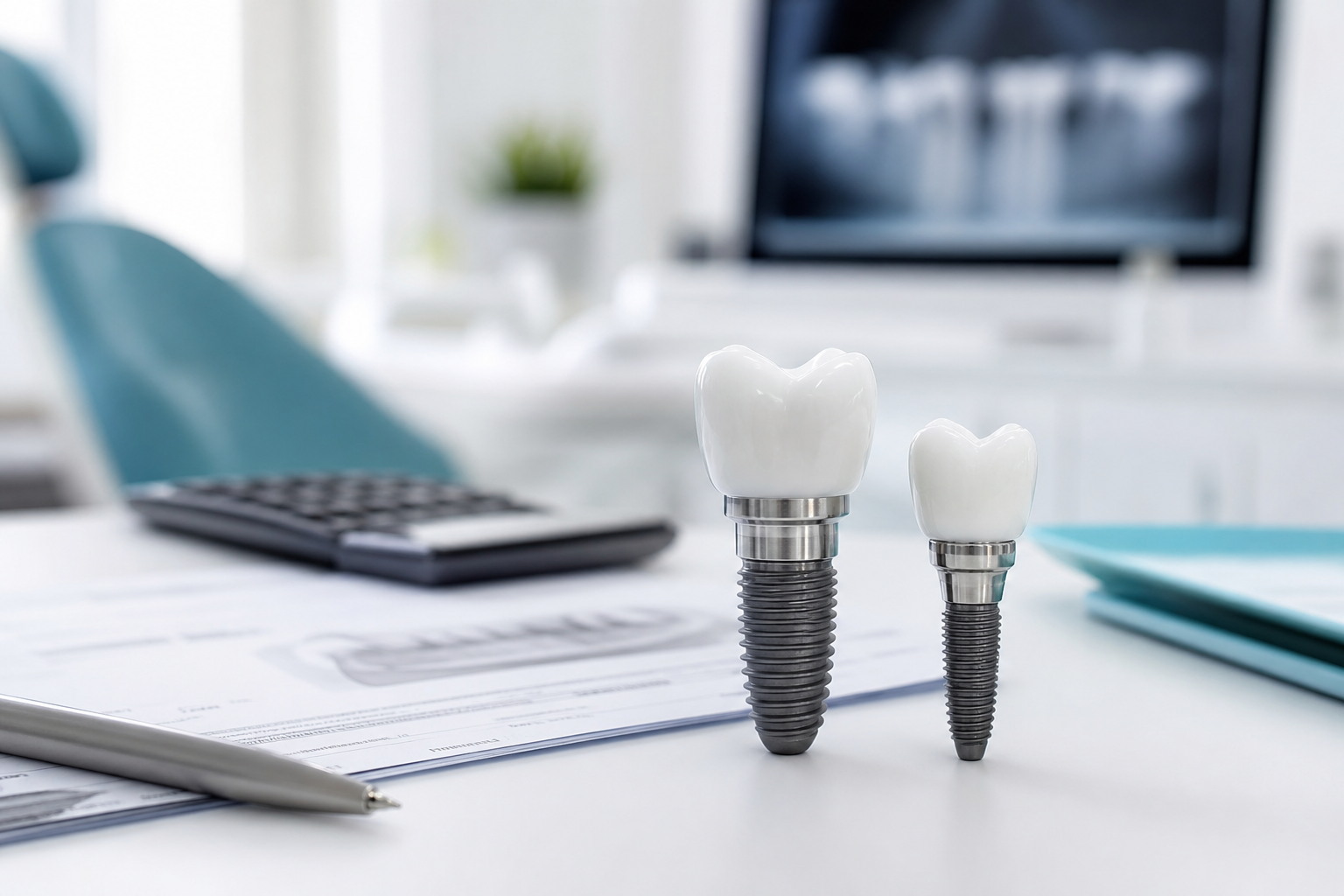
You searched types of dental implants cost because you want to compare single-tooth quotes, All-on-4 packages, and mini-implant ads without assuming they describe the same treatment.
One page lists single implants at $3,500. Another promotes All-on-4 from $14,999 per arch. A third mentions mini implants at $799 each. Those numbers can all appear for the same search, yet they reflect different hardware counts, timelines, and finish lines.
The useful question is not "Which type is cheapest?" It is: Which implant type fits my situation, and does each quote include the same line items?
This 2026 patient budgeting guide explains what types of dental implants cost usually refers to in real treatment plans, which planning ranges help US patients compare options, and how to read a dental implant quote before you commit. It is not medical advice, insurance advice, tax advice, or a promise of coverage, savings, or financing approval.
Three Questions Before You Trust a Type-Specific Price
When you compare implant types, clarify these first:
- Category — single tooth, bridge, full arch, or denture stabilization?
- Finish line — implant post only, temporary during healing, or final tooth or arch delivered?
- Conditions — what happens if grafting, extractions, or a different type is recommended after imaging?
Online ranges help you spot incomplete quotes. They do not replace a written estimate after exam and imaging.
When Type Comparison Helps—and When It Is Too Early
Compare types once you know your restoration goal. If you are replacing one tooth, single-implant and bridge pricing may both be relevant. If you are missing most teeth in an arch, full-arch and mini-stabilization quotes belong in separate columns—not averaged together.
Wait on final numbers until imaging is reviewed. Bone volume, bite force, and gum health can shift which type a clinician considers appropriate. Cost should not be the only factor in that decision—and only a qualified dental professional can determine clinical suitability after an exam.
Use type-level ranges to sanity-check quotes and ask better questions, not to self-select surgery online.
What "Types of Dental Implants Cost" Usually Means
The search phrase sounds like a menu of fixed prices. In practice, implant pricing is tied to restoration scope and how many implants support the final teeth.
The American Dental Association's MouthHealthy implant guide describes posts surgically placed in the jaw to anchor replacement teeth, with phases that can include healing and final restoration.
Mayo Clinic's dental implant surgery overview notes treatment may involve exams, imaging, tooth removal, bone grafting, implant placement, abutment placement, and the artificial tooth.
Fees often arrive in stages regardless of type:
- Diagnostic phase — exam, photos, models, panoramic X-ray or CBCT.
- Surgical phase — extractions, grafting if needed, implant placement, sedation.
- Healing phase — follow-ups; sometimes a temporary tooth or interim arch.
- Restorative phase — abutment and crown, bridge, or full-arch prosthetic months later.
A single-tooth quote and a full-arch package are not interchangeable totals—even when both use the word "implant."
Note: Be cautious with ads quoting very low per-implant prices. They often refer to the metal post—not the complete tooth you chew with, and not the imaging or grafting many cases require.
2026 US Planning Ranges by Implant Type
Treat every figure below as a planning range for comparison shopping. Your clinic's written estimate may fall below or above these bands depending on location, materials, sedation, and included services.
| Implant type | Common 2026 US planning range | What to verify in the quote |
| Single tooth (post + abutment + crown) | About $3,000 – $6,000 per tooth | Whether crown and imaging are included |
| Implant-supported bridge | About $5,000 – $15,000 total | How many implants support the bridge |
| All-on-4 (one full arch) | About $15,000 – $30,000+ per arch | Temporary teeth, final material tier, sedation |
| All-on-6 / multi-implant full arch | About $25,000 – $40,000+ per arch | Implant count, prosthetic material, warranty terms |
| Mini dental implants (often per implant) | About $500 – $1,500 per implant | Whether this is stabilization only vs full replacement |
For broader national context, see Dental Implants Cost: What You Can Expect to Pay in the US. For arch-level detail, read Cost of Full Mouth Dental Implants: Complete Pricing Guide for the US.
Full mouth dental implants cost for both arches commonly lands around $30,000 – $60,000+ in planning ranges—with wide swings depending on whether quotes bundle temporaries, final zirconia, and sedation.
Mini Example: Three Types, Three Totals
Imagine a patient missing most lower teeth. Three clinics answer types of dental implants cost differently:
- Clinic A: "$899 mini implant special" — per narrow implant only; denture retrofit, imaging, and follow-ups not listed.
- Clinic B: "$18,500 All-on-4 lower arch" — may bundle surgery, four implants, temporary teeth, and a defined final acrylic hybrid—with grafting conditional.
- Clinic C: "$4,800 per tooth × six teeth" — individual implant crowns proposed where a full-arch design might use fewer implants.
All three are "implant" quotes. Without matching clinical goal, finish line, and line items, you cannot tell which total belongs in your budget.
Cross-type tip: Full-arch quotes often bundle surgery, temporaries, and interim teeth that single-tooth quotes list as separate phases. When you compare types, separate package inclusions from per-unit pricing before you judge which column is lower.
Single Tooth Implant Cost
Typical use: One missing tooth replaced with an implant-supported crown.
Budgeting pitfall: The crown is often delivered months after implant placement and may be billed separately. A quote that ends at "implant placed" is not the same as a functioning tooth delivered.
Quote-check focus: Crown timing and fee, extraction and graft add-ons, implant and crown material tier.
Implant-Supported Bridge Cost
Typical use: Several adjacent missing teeth supported by two or more implants instead of one implant per tooth.
Budgeting pitfall: A bridge quote may assume a fixed number of implants. CBCT review can change that design—and the total.
Quote-check focus: Implant count, provisional vs final bridge, and what happens if one site needs longer healing.
All-on-4 and Full-Arch Implant Cost
Typical use: Replacing most or all teeth in one arch with a fixed prosthetic supported by four strategically placed implants.
Budgeting pitfall: Arch packages frequently include temporary teeth on surgery day while single-tooth plans may not. Missing that difference makes All-on-4 look artificially expensive—or artificially cheap if the final zirconia arch is excluded.
Quote-check focus: Temporary teeth, final material tier, extractions, and sedation. For a deeper arch-pricing walkthrough, see All-on-4 Dental Implants Cost: A 2026 Guide to Pricing and Value.
All-on-6 and Multi-Implant Full-Arch Cost
Typical use: Full-arch restoration with additional implants when a clinician expects more support points may be appropriate for the case.
Budgeting pitfall: Each added implant increases surgical and hardware fees. Compare quotes by implant count and prosthetic tier, not headline arch price alone.
Quote-check focus: Why more than four implants are proposed, warranty or redo terms, and whether upper and lower arches are separate finish lines.
Mini Dental Implant Cost
Typical use: Often discussed for stabilizing removable dentures when standard implant diameter may not fit available bone.
Budgeting pitfall: Per-implant mini pricing is not a shortcut to budget for standard single-tooth replacement or a fixed full arch. Attachment retrofits, denture adjustments, and maintenance belong in the real total.
Quote-check focus: Stabilization goal vs tooth replacement goal, number of minis required, and long-term attachment maintenance costs.
Line Items That Belong on Any Dental Implant Quote
Humana's dental implant coverage overview notes implant bills can include consultations, X-rays, pre-surgical care such as extractions or grafts, anesthesia, and the crown. Use that as a checklist when you review paperwork—not as a promise about what your plan will pay.
| Line item | Why it changes your budget | Ask |
| Exam and treatment planning | May be separate from surgery | "Is the consult fee credited toward treatment?" |
| Panoramic X-ray, CBCT, or 3D scan | Drives surgical guides and fees | "Is 3D imaging included or billed separately?" |
| Extractions | Common before full-arch plans | "Are extractions in this quote?" |
| Bone graft or sinus lift | Frequent after imaging review | "If grafting is needed, what is the range?" |
| Implant post (fixture) | Priced per unit; count varies by type | "How many implants are included?" |
| Abutment or multi-unit bridge hardware | Connects implants to final teeth | "Are abutments included for every implant?" |
| Crown, bridge, or full-arch prosthetic | Material tier shifts totals | "Which material tier is in this price?" |
| Temporary teeth | Especially important for arch plans | "Will I leave with temporaries, and are they included?" |
| Sedation or anesthesia | May involve another provider | "How is sedation billed?" |
| Follow-up visits | Healing checks add up over months | "How many post-op visits are included?" |
Copy this table into notes before your consultation. Two clinics quoting the same implant type at a similar total may still be describing different categories.
Five Cost Drivers That Shift Pricing Between Types
1. Implant count
A single tooth needs one implant. A bridge may use two. All-on-4 uses four per arch. All-on-6 uses six. More fixtures generally mean higher surgical and hardware fees.
2. Prosthetic material tier
Full-arch plans may offer acrylic hybrid bridges, upgraded ceramics, or zirconia at different price points. Material tier affects lab fees and long-term maintenance—not just appearance.
3. Pre-work discovered on imaging
Bone grafting, sinus lifts, periodontal treatment, and extractions are common reasons a type-specific quote expands after CBCT review. Budget a conditional buffer when imaging is not complete.
4. Clinical team and revision path
Ask who places implants, who delivers the final restoration, and how redos are handled. Team structure can influence fees and where you go if healing does not go as planned.
5. Location and market
Urban specialist centers and high-cost-of-living markets often sit higher in the range than smaller-town general practices. Compare offices in your market when judging whether a quote is an outlier.
How to Compare Quotes Across Implant Types
Run each estimate through the same checklist:
- Same clinical goal — stabilization vs single tooth vs full arch.
- Same finish line — post-only vs functioning tooth or arch delivered.
- Same conditional language — how each quote handles "if grafting is needed."
- Same timing — when temporaries and final teeth are placed and paid for.
- Same warranty terms — what happens if an implant does not integrate.
If an office cannot itemize the estimate, treat the total as incomplete—not automatically dishonest, but not ready to anchor your household budget.
When you are evaluating full mouth dental implants cost, request separate written estimates for upper and lower arches even if a clinic markets a single combined package. That makes cross-type comparisons easier to audit.
What to Ask Your Dentist About Type and Cost
Bring these questions to your consultation or phone call:
- Which implant type are you recommending for my case, and what alternatives did you consider?
- Is this price for the post only, or post + abutment + final tooth or arch?
- How many implants are included, and could that number change after imaging?
- What grafting, extraction, or temporary costs could appear after CBCT?
- When is the final restoration delivered, and what triggers a higher total?
- Can I receive an itemized written estimate and procedure codes before a deposit?
You can phrase it simply: "Before I commit, can we walk through which implant type this quote assumes and what might be added later?"
How Does Dental Implant Insurance Apply by Type?
Dental implant insurance may help with part of treatment, but it rarely eliminates the out-of-pocket portion—especially for full-arch plans with large totals. Plans can treat exams, imaging, extractions, grafts, implant bodies, abutments, crowns, temporaries, and sedation differently, and an annual maximum can cap payments long before the full quote is addressed.
Practical insurance budgeting steps:
- Ask the clinic for a pre-treatment benefit estimate by procedure code when possible.
- Call the insurer to verify remaining annual maximum, waiting periods, and implant limitations.
- Budget as if insurance pays less than the front desk hopes.
- Ask whether any line items might be billed medically—then verify with both insurers rather than assuming.
A clinic that "accepts your insurance" is not the same as a clinic that confirmed what your plan will pay for surgery, grafting, or the final crown.
Paying What Insurance Does Not Cover
When insurance leaves a gap, patients often use pre-tax accounts or payment plans.
The IRS medical and dental expense publication includes dental treatment for prevention or alleviation of dental disease as a medical expense category, while excluding cosmetic-only services such as teeth whitening. HSA or FSA eligibility still depends on your account rules and documentation—verify with your administrator, not the reception desk.
Third-party financing such as CareCredit can spread confirmed out-of-pocket costs over time, but approval, rates, promotional deadlines, and deferred-interest rules vary. Financing manages cash flow; it does not reduce the underlying treatment price.
Red Flags Before You Anchor Your Budget
Pause and ask for more detail if you notice:
- A type-specific price that cannot be broken into line items.
- Pressure to pay today to lock in a discount.
- "Insurance will cover most of it" without a written benefit estimate.
- Mini-implant pricing presented as equivalent to full single-tooth or arch replacement.
- No discussion of temporaries, grafting, or who performs surgery versus restoration.
None of these automatically means a clinic is acting improperly. They are signals the quote is not ready to support a financial decision.
Simple Budgeting Worksheet by Type
Before you commit, sketch your own range for the implant type under discussion:
- Low scenario — minimal add-ons, standard materials, quote total with defined inclusions.
- Mid scenario — likely grafting or temporary costs the coordinator mentioned.
- High scenario — premium materials, sedation, extra implants, or longer healing requiring more visits.
Subtract only verified insurance payments from each scenario—not hoped-for coverage. The gap is what HSA/FSA funds or financing would need to cover.
Where MyDentalCost Fits
A consultation tells you what one clinic proposes for a given implant type. It does not always show whether that proposal is typical for your area, bone condition, or restoration choice.
The MyDentalCost quiz helps you organize implant cost factors—single tooth vs bridge vs full arch, likely add-ons, and regional context—before you walk in. That can make your quote-check questions sharper when you compare types of dental implants cost across offices. It is a planning tool, not a substitute for a clinical exam, itemized estimate, or insurer verification.
Bottom Line
Types of dental implants cost is not one number—it is a set of planning ranges tied to restoration scope, implant count, and included line items. In 2026, the safest answer is built from itemized dental implant quote comparisons on the same categories, with insurance verified separately and conditional add-ons planned upfront.
If the numbers still feel muddy after you ask direct questions, keep shopping. A clear quote is part of the service—not a bonus.