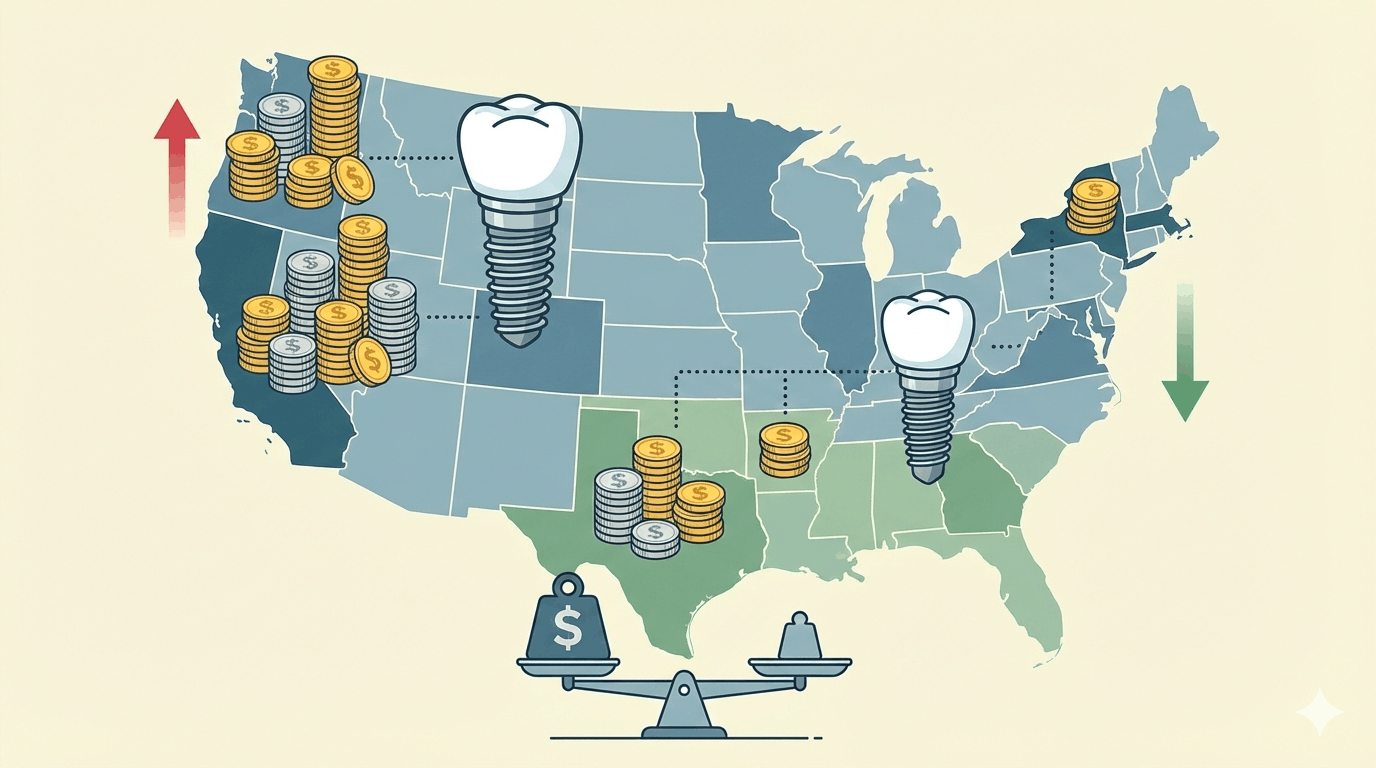
If you are researching the full cost for dental implants, you have likely realized that your zip code is just as important as your jawbone density. Searching for a flat price across the United States is an exercise in futility; a board-certified specialist in Midtown Manhattan operates under a completely different financial overhead than one in downtown Salt Lake City.
For patients in the 45–65 demographic, this isn’t just a medical procedure it’s a major financial investment. You want the security of a permanent smile, but you are rightfully anxious about "the dental pricing trap," where initial quotes for a single implant balloon into a $60,000 invoice for a full-arch restoration.
As an advocate, my goal is to help you navigate this "Geographic Premium." By understanding how prices shift from state to state and what specific clinical line items should actually cost, you can stop being a victim of "sticker shock" and start being a savvy healthcare consumer.
The "full cost" of an implant isn't just the titanium screw. It is a combination of the surgeon's expertise, the local cost of living, and the quality of the dental lab used to manufacture your teeth. Based on industry benchmarks and data from CareCredit, the national average for a single Endosteal implant sits at $4,344, but that number is a starting point, not a ceiling.
Before you can compare state pricing, you must ensure you are comparing "all-in" quotes. Many clinics lead with a "surgical fee" only to add thousands in extras later.
In every state, you will find two types of pricing: General Dentist pricing and Specialist pricing (Oral Surgeons or Periodontists). While a generalist may charge 15% less, specialists have significantly lower failure rates for complex full-mouth cases. According to the American Association of Oral and Maxillofacial Surgeons (AAOMS), the long-term success rate of implants is over 95% when performed by a trained specialist.
Pro Tip: Always ask if your crown is "Screw-Retained" or "Cement-Retained." Screw-retained crowns are easier to maintain and repair if a chip occurs, potentially saving you thousands in replacement costs over a decade.
The following table reflects the current 2026 market averages for specific procedures. Note how the complexity of the hardware—such as Zygomatic implants for severe bone loss—dramatically changes the "full cost."
Pro Tip: "Domestic Arbitrage" is a legitimate strategy. If you live in New Jersey or Connecticut, flying to a specialist in Arizona for a full-mouth case can save you $10,000 to $15,000, even after factoring in a luxury hotel stay for your recovery.
Knowing the full cost for dental implants is only half the battle; knowing how to pay for them is where the real savings happen.
Most dental insurance policies have a dismal annual maximum of $1,500 to $2,000. However, if you schedule your surgery in December (placing the implants) and your final restoration in January (placing the teeth), you can apply two years’ worth of maximum benefits to a single case.
Because dental implants are a medical necessity, you can use your Health Savings Account (HSA) or Flexible Spending Account (FSA). By paying with pre-tax dollars, you are effectively getting a 25-30% discount depending on your tax bracket. For a $50,000 full-mouth case, this is a **$15,000 savings** far more than any insurance policy will ever give you.
When you are quoted for a full arch, the material matters.
Pro Tip: Many corporate dental chains use generic, non-branded implants to save on costs. Always ask for a "Letter of Authenticity" for your implants (e.g., Nobel Biocare or Straumann). This ensures that if you move to a different state, any future dentist will have the compatible tools to service your implants.
Navigating the full cost for dental implants across the U.S. requires a shift in mindset: you are no longer a patient; you are a project manager for your own health. By looking beyond your local "big-box" clinic and considering the value hubs in Arizona or Utah, you can access world-class surgeons and premium zirconia materials for a fraction of the cost in high-tier coastal cities.
Remember: Value > Price. A failed implant is the most expensive dental procedure in the world. Saving $1,000 by choosing an unvetted general dentist is a risk that rarely pays off. Informed patients win by choosing the right state, the right specialist, and the right tax-advantaged accounts.
Don’t guess with your health or your wallet.
Our Dental Implant Cost Evaluation compares local US pricing, state-to-state savings, and vetted international options customized to your mouth and your goals.
Get your personalized report today.