If you are researching the full dental implants cost, you have likely realized that the American healthcare system is pricing many people out of their own smiles. For patients in the 45–65 age bracket, the prospect of spending $60,000 on a full-mouth restoration feels less like a medical necessity and more like a second mortgage.
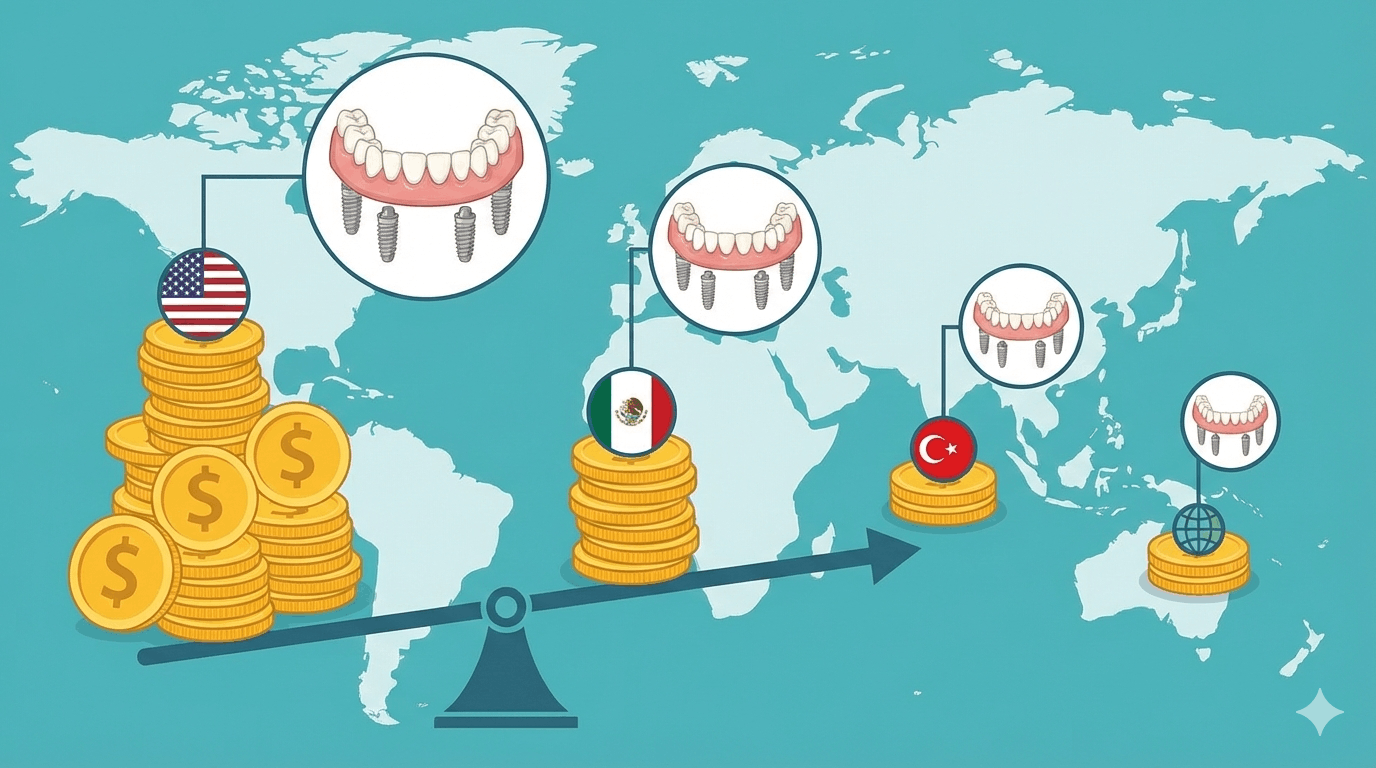
This financial pressure has given rise to a massive global industry: Dental Tourism. Today, US residents are increasingly looking toward Mexico, Turkey, and Costa Rica to find relief from domestic pricing. However, as an advocate, I must warn you: the "cheapest" price often carries hidden risks that don't appear on a brochure.
To make an informed decision, you need to look past the marketing and understand the true cost of global dental care—including travel, follow-up care, and material standards. This guide breaks down the international pricing landscape of 2026 to help you decide if staying home or heading abroad is the right move for your health and your wallet.
The massive discrepancy in full dental implants cost between the US and countries like Mexico or Turkey isn't always a reflection of "lower quality." Instead, it is a reflection of the economic ecosystem.
Pro Tip: When looking abroad, verify the brand of the implant fixture. Leading brands like Straumann or Nobel Biocare have "Global Warranties." If a cheaper "local" brand is used in Turkey and it fails when you return home, your local US dentist will not have the proprietary tools to fix it.
The following table outlines the preliminary "all-in" costs for a full-arch restoration (one jaw) using premium materials like Zirconia. These figures represent vetted, high-end clinics in each region, not "basement" bargain prices.
Whether you choose to stay in the US or travel abroad, "smart saving" is about reducing risk, not just the bottom line.
If the risks of international travel feel too high, consider Domestic Arbitrage. As we've discussed, the cost of an implant in Manhattan is vastly different from the cost in Scottsdale, Arizona, or Salt Lake City, Utah. You can often save 30%–40% on the full dental implants cost simply by flying to a US "value hub." This keeps you under US dental board regulations while providing significant savings.
Many patients forget that full implants are a multi-stage process.
Before committing to an international clinic, verify their credentials. While the American Association of Oral and Maxillofacial Surgeons (AAOMS) sets the standard in the US, international clinics should hold ISO certifications or JCI (Joint Commission International) accreditation to ensure they meet global safety and sterilization benchmarks.
Pro Tip: Ask for the "Lab Prescription." This document lists the exact materials used in your bridge. Ensure they are using FDA-approved or CE-marked Zirconia. Some discount clinics use cheaper industrial-grade ceramics that are more prone to fracturing under bite pressure.
In 2026, the full dental implants cost is no longer a localized number. You are part of a global market. If you are comfortable with travel and have a straightforward case, Mexico or Costa Rica can offer life-changing results for a fraction of US prices. However, if your case is complex or you value the safety net of US legal and clinical oversight, domestic arbitrage to a lower-cost state may be the smarter investment.
The informed patient wins by choosing the path that balances financial savings with long-term biological success. A "cheap" implant that fails in three years is the most expensive mistake you can make.
Don’t guess with your health or your wallet.
Our Dental Implant Cost Evaluation compares local US pricing, state-to-state savings, and vetted international options customized to your mouth and your goals.
Get your personalized report today.