
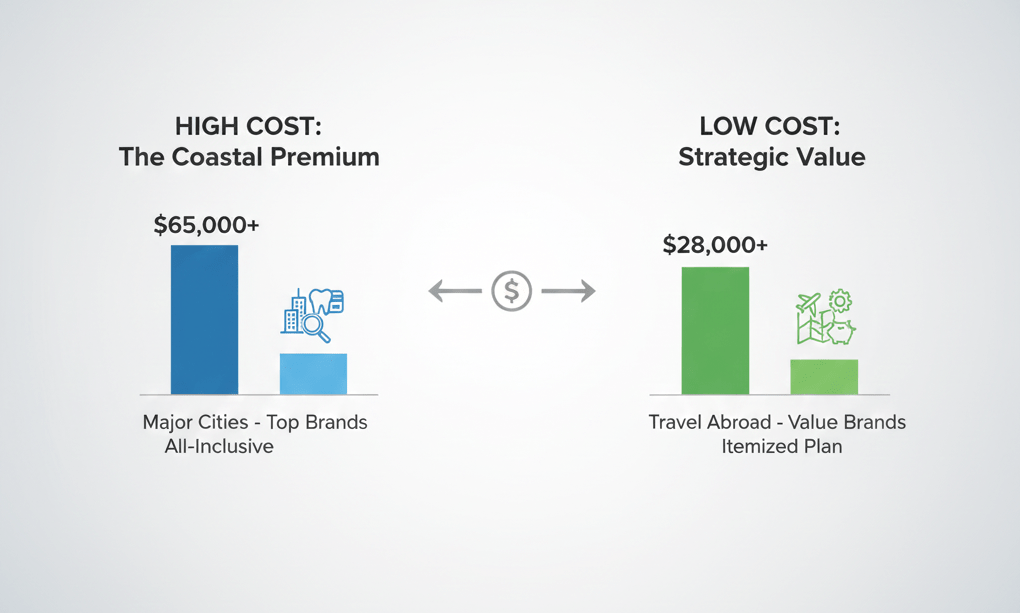
If you’ve been quoted $28,000 on the low end and $65,000+ on the high end for full mouth dental implants, you’re not imagining things - the price spread really is that wide.
What’s more unsettling is that two patients with similar mouths can receive quotes that differ by $10,000 to $25,000 within the same city.
That’s not because dentistry is mysterious.
It’s because pricing transparency in implant dentistry is notoriously poor.
This guide is written to pull back the curtain.
We’ll reverse-engineer the real costs, explain where the money actually goes, and show you how informed patients avoid overpaying - without gambling on quality.
When a clinic quotes you for full mouth dental implants, you’re not buying “teeth.”
You’re paying for a system, a process, and a risk transfer.
Here’s what that includes.
This is the titanium (or zirconia) anchor placed into the jawbone.
High-quality systems - like Straumann or Nobel Biocare - are engineered for long-term integration and supported by decades of clinical data
(see: American Academy of Periodontology).
Unknown or private-label implants may be cheaper upfront, but replacement parts can become impossible to source years later.
This is the connector between the implant and the tooth.
It affects:
Many low-price ads quietly substitute generic abutments, which can compromise fit and longevity.
This is where huge price variation occurs.
Materials range from:
Pro Tip: If a quote doesn’t clearly separate implant, abutment, prosthetic, and surgical fees assume something important is missing.
You’ll see ads promising implants for $999 or $1,499.
What they usually mean:
Once everything is added, those cases often end up costing more than transparent, all-inclusive clinics.
For full mouth dental implants in the U.S., these are the ranges patients are actually paying in 2026.
Market TierTypical Cost Range (USD)What This Usually IncludesLow$28,000 – $35,000Acrylic or hybrid teeth, limited warrantiesAverage$38,000 – $50,000Zirconia options, mid-tier labsHigh$55,000 – $65,000+Premium materials, extended guarantees
If you’re being quoted far outside these ranges, the question isn’t “Is this good or bad?” - it’s why.
Well-informed patients don’t blindly accept the first quote.
They use strategy.
Dental arbitrage simply means paying fair value instead of inflated pricing - not cutting corners.
Within the U.S., prices vary dramatically by geography.
Patients often save by:
The care can be identical - the overhead is not.
Pro Tip: If two clinics use the same implant system and materials, but one charges $15k more, you’re paying for location - not outcomes.
Some patients explore treatment abroad - commonly in:
This can reduce costs by 40–60%, but only when:
The NIH has published extensively on implant survival rates when protocols are followed.
Price alone should never decide your care.
Here’s how experienced patients evaluate clinics.
Ask directly:
Who is placing the implants?
Organizations like the AAP outline training standards clearly.
Experience matters.
Ask:
Avoid vague answers.
Reputable clinics:
Pro Tip: High-pressure discounts are a red flag - not a benefit.
Cut-rate dentistry often costs more - just later.
Common issues include:
According to long-term data summarized by Mayo Clinic, revision implant cases are significantly more complex and expensive.
Beyond money, failed implants take a psychological toll - months of discomfort, embarrassment, and lost trust.
Full mouth dental implants are not a commodity.
They are a life-changing medical investment.
Patients who win are not the ones who find the lowest price - they’re the ones who understand:
Don’t guess with your health or your wallet.
Why Use Our Evaluation?
Get your personalized report today.