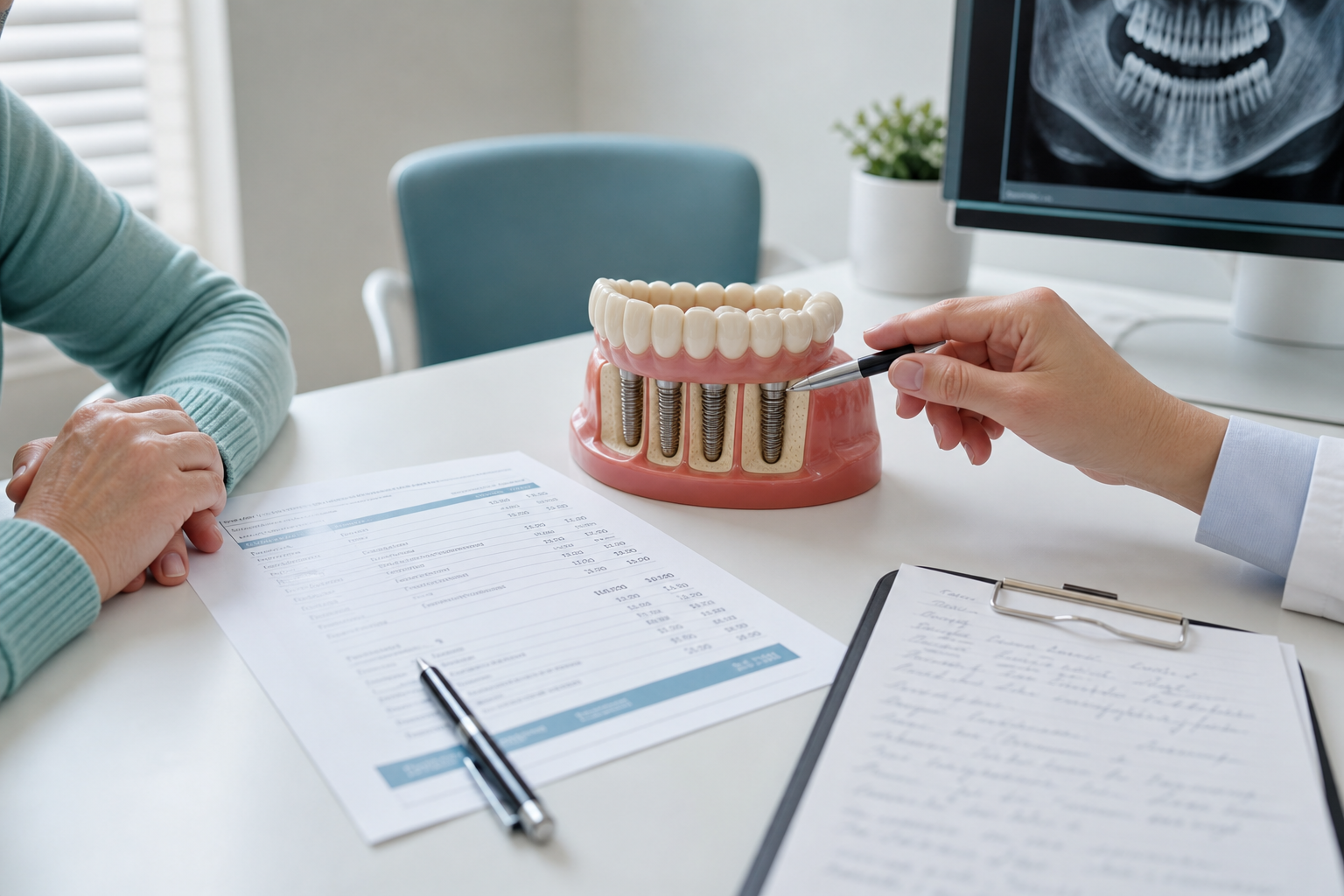
You searched full mouth dental implants cost because you need a household number—not a marketing headline that collapses once imaging is done.
Then the paperwork lands. One clinic quotes $20,500 per arch as a "turnkey" package. Another advertises $39,900 for a full-mouth restoration. A third mentions $52,000 after CBCT—and the coordinator asks for a deposit before you have matched line items.
Before you trust any of those figures, ask a sharper question: What is the finish line—implant posts placed, temporary teeth delivered the day of surgery, or final prosthetics you actually chew with?
Full mouth dental implants cost is rarely one sticker price. It is a bundle of phases, materials, and conditional add-ons that clinics package in different ways. This buyer guide breaks down how full-arch dental implant quote estimates are usually structured, which package inclusions belong on paper, and where hidden fees commonly inflate the final bill.
This is not medical advice, insurance advice, tax advice, or a promise of coverage, savings, or financing approval. It is a practical framework for reading quotes and comparing full-arch options on the same categories. Verify clinical suitability with a qualified dental professional.
Why Two "Full Mouth" Quotes Can Differ by $15,000 or More
Full mouth dental implants replace all missing teeth in the upper jaw, lower jaw, or both. Modern plans use strategically placed implants to support a fixed arch of prosthetic teeth—not an individual implant for every tooth.
The American Dental Association's MouthHealthy implant guide describes posts surgically placed in the jaw to anchor replacement teeth, with phases that can include healing and final restoration.
Mayo Clinic's dental implant surgery overview notes treatment may involve exams, imaging, tooth removal, bone grafting, implant placement, abutment placement, and the artificial tooth.
That multi-step structure is why quotes diverge. The gap is usually different package inclusions, not one clinic being universally "cheaper":
- Scope: one arch vs both clearly stated—or not.
- Finish line: surgery only vs temporaries vs final prosthetics included.
- Material tier: standard acrylic hybrid vs upgraded zirconia or ceramic.
- Conditional work: grafting, extractions, and sedation listed as "if needed" with or without a price range.
For broader US range context, see Cost of Full Mouth Dental Implants: Complete Pricing Guide for the US. For arch-specific pricing, read All-on-4 Dental Implants Cost: A 2026 Guide to Pricing & Value.
Three Ways Clinics Package Full-Arch Quotes
When you evaluate full mouth dental implants cost, identify which packaging model you are reading:
1. Phase-based estimates
Diagnostics, pre-surgical work, surgery, temporaries, and final prosthetics appear as separate line items or invoices. The first number looks smaller; the total emerges over months.
2. Per-arch packages
A bundled price for one jaw (upper OR lower). Marketing that says "full mouth" does not always mean both arches—confirm scope before you compare.
3. Full-mouth packages
A single headline for both arches, often with material tiers (standard vs premium) and conditional add-ons for grafting or sedation.
Note: Be cautious with ads quoting very low per-arch prices. They often refer to the surgical phase or implant posts—not the final bridge, temporaries, imaging, grafting, or follow-up care many cases require.
Full-Arch Approaches and What They Mean for Your Quote
Most full-mouth plans use one of these approaches. Which system fits your mouth is a clinical decision your dental team makes after exam and imaging—the table below is for quote comparison and budgeting only, not for choosing treatment by price.
| Approach | Typical implant count per arch | Package inclusion check |
| All-on-4 | Four implants | Confirm implant count and brand on the estimate |
| All-on-6 | Six implants | More hardware and surgery time; may add cost vs All-on-4 |
| Implant-supported full bridge | Varies by case | Quote should specify implant count and bridge design |
None of these labels automatically tells you what is included in the price. Two All-on-4 packages can list the same approach while one includes final zirconia arches and the other bills finals separately.
The Phase-by-Phase Anatomy of a Full-Arch Quote
Understanding phases helps you spot what a headline price skips:
- Diagnostic phase — exam, photos, models, panoramic X-ray or CBCT, treatment plan.
- Pre-surgical phase — extractions, periodontal treatment, bone grafting or sinus lift if needed.
- Surgical phase — implant placement, sedation, immediate temporaries in many full-arch plans.
- Healing phase — follow-up visits over several months while implants integrate.
- Restorative phase — final full-arch bridge or hybrid prosthetic.
A quote covering only the surgical phase is a different financial commitment than an all-inclusive plan that includes final teeth for both arches.
Package Inclusion Map: Line Items That Belong on Paper
Humana's dental implant coverage overview notes implant bills can include consultations, X-rays, pre-surgical care such as extractions or grafts, anesthesia, and the crown or prosthetic. Use that as a verification list when you review a dental implant quote—not as a promise about what your plan will pay.
| Line item | Why it changes your total | Inclusion question |
| Exam and treatment planning | May be separate from surgery | "Is the consult fee credited toward treatment?" |
| CBCT or 3D imaging | Drives surgical guides and fees | "Is 3D imaging included or billed separately?" |
| Extractions (multiple teeth) | Common before full-arch surgery | "Are all extractions in this quote?" |
| Bone graft or sinus lift | Frequent after imaging review | "If grafting is needed, what is the cost range?" |
| Implant posts and abutments | Hardware per arch; count varies by system | "How many implants per arch, and which brand?" |
| Temporary full-arch teeth | Often placed same day as surgery | "Will I leave with temporaries, and are they included?" |
| Final bridge or hybrid prosthetic | May be months after surgery | "When is the final arch delivered and billed?" |
| Sedation or anesthesia | Full-arch cases often use IV sedation | "Which sedation options are offered and how are they billed?" |
| Follow-up visits and maintenance | Healing checks over months | "How many post-op visits are included?" |
Copy this table into notes before your consultation. Two clinics quoting similar totals may be describing different categories.
Temporaries, Finals, and Material Tiers
Full-arch quotes often split prosthetic costs across time—and material choice can move full mouth dental implants cost by thousands per arch:
- Immediate temporaries — Many full-arch surgeries deliver a temporary bridge the same day. Some packages include it; others bill it separately or fold it into a "surgical package" only.
- Final prosthetic — The permanent full-arch bridge may be fabricated weeks to months later. If the headline quote is "surgery only," the final prosthetic can represent a large add-on depending on materials and lab fees.
- Material tier — Acrylic hybrid bridges, upgraded ceramics, and zirconia options sit at different price points. Material choice affects lab fees and long-term maintenance expectations—not just appearance.
When you compare quotes, confirm when temporaries and finals are placed and when each is paid for. A lower surgical quote plus a separate restorative invoice can exceed a higher all-inclusive package.
Hidden Fees and Inclusion Gaps That Inflate Full-Arch Bills
Low advertised prices often describe a slice of the full journey. These gaps show up repeatedly when patients compare package inclusions:
| Inclusion gap | What patients often assume | What to verify in writing |
| Surgical-only pricing | "Full mouth" includes final teeth | "Is the final prosthetic included or a separate phase?" |
| Post-only advertising | The quote covers a complete arch | "Does this include abutment and prosthetic?" |
| Imaging and surgical guides | Scans are part of the consult | "Is CBCT and guide fabrication included?" |
| Grafting without a range | Bone work is unlikely for them | "What is the grafting price range if imaging shows need?" |
| Separate sedation billing | Anesthesia is in the package | "Is IV sedation included or billed separately?" |
| Premium material upsell | The quote covers the top material tier | "Which material tier is this price based on?" |
| Maintenance outside the plan | Follow-ups are unlimited | "What visits and cleanings are included for how long?" |
Note: None of these patterns automatically means a clinic is acting improperly. They are reasons to demand itemized paperwork before you anchor your budget.
Mini Example: Same Headline Range, Different Package Inclusions
Imagine two clinics both discussing full mouth dental implants cost in the $38,000–$45,000 band:
- Clinic A: "$41,000 full mouth" — may include both arches with standard acrylic hybrid temporaries and final teeth, but lists grafting, premium zirconia upgrade, and IV sedation as add-ons with no ranges on the first page.
- Clinic B: "$43,500 full mouth" — may include both arches with zirconia finals, CBCT, extractions, standard sedation, and defined follow-ups, with grafting as the main conditional add-on backed by a written range.
Both numbers can appear on the same search results page. Without matching inclusions and the same finish line, you cannot tell which estimate fits your expected outcome—or whether Clinic A's add-ons would close the gap.
2026 Planning Ranges for Full-Arch and Full-Mouth Scope
Treat every figure below as a planning range for comparison shopping—not a guaranteed price. Your clinic's written estimate may fall below or above these bands depending on location, materials, sedation, and pre-work.
When people search the average cost of dental implants in a full-arch context, they are usually asking about these scopes:
| Treatment scope | Common 2026 US planning range | Package inclusion focus |
| One full arch (upper OR lower) | About $15,000 – $30,000+ per arch | Temporaries, final material tier, sedation, pre-work |
| Both arches (full mouth) | About $30,000 – $60,000+ | Whether pricing is one package or two arch quotes |
| Premium material full mouth (both arches) | Often toward the upper end of the range or above | Material tier, lab fees, warranty terms |
Use the ranges to ask sharper questions—not to anchor on one national average. Full mouth dental implants cost moves quickly when temporaries, zirconia upgrades, or grafting are priced separately.
How Payment Schedules Split Across Phases
Full-arch treatment rarely bills as one lump sum. Common patterns include:
- Deposit or consultation fee — may apply toward treatment or cover imaging; refund policies vary.
- Surgical payment — due at implant placement, sometimes including temporaries.
- Restorative balance — due when final arches are delivered, weeks or months later.
Ask for a payment schedule tied to milestones so you are not surprised by a large restorative invoice during healing. Financing and HSA/FSA planning work better when you know when each balance is due—not just the headline total.
Dental Implant Insurance on Full-Arch Quotes
Insurance may help with part of implant treatment, but it rarely eliminates the out-of-pocket portion on full-mouth cases. Plans can treat exams, imaging, extractions, grafts, implant bodies, abutments, prosthetics, temporaries, and sedation differently—and an annual maximum can cap payments long before the full quote is addressed.
Because full-mouth treatment often spans multiple appointments and sometimes two calendar years, verify whether benefits reset between the surgical phase and final prosthetic delivery. A plan's annual maximum may apply separately each year—but that still may cover only a fraction of a $30,000–$60,000+ plan.
Practical dental implant insurance steps for full-arch quotes:
- Ask the clinic for a pre-treatment benefit estimate by procedure code when possible.
- Call the insurer to verify remaining annual maximum, waiting periods, and implant limitations.
- Budget as if insurance pays less than the front desk hopes.
- Ask whether any line items might be billed medically—then verify with both insurers rather than assuming.
A clinic that "accepts your insurance" is not the same as a clinic that confirmed what your plan will pay for surgery, grafting, or the final prosthetic.
Financing, HSA, and FSA for Out-of-Pocket Gaps
When insurance leaves a gap, patients often use pre-tax accounts or payment plans.
The IRS medical and dental expense publication includes dental treatment for prevention or alleviation of dental disease as a medical expense category, while excluding cosmetic-only services such as teeth whitening. HSA or FSA eligibility still depends on your account rules and documentation—verify with your administrator, not the reception desk.
Third-party financing such as CareCredit can spread confirmed out-of-pocket costs over time, but approval, rates, promotional deadlines, and deferred-interest rules vary. Financing manages cash flow; it does not reduce the underlying treatment price.
Package Inclusion Scorecard: Compare Two Quotes
Run both estimates through the same rows before you sign or pay a deposit:
| Inclusion category | Clinic A | Clinic B |
| Jaws covered (upper / lower / both) | ||
| Finish line (posts / temporaries / finals) | ||
| Temporaries included? | ||
| Final prosthetic included? | ||
| Material tier quoted | ||
| CBCT / imaging included? | ||
| Grafting priced with range? | ||
| Sedation included? | ||
| Warranty / redo policy in writing | ||
| Payment milestone schedule attached |
Leave blank cells empty during the visit, then fill them in before any deposit. Two totals that look close on paper can diverge sharply once package inclusions match.
What to Ask Your Dentist Before You Commit
Bring these questions to your consultation or phone call:
- Does this quote cover one arch or both?
- Which approach (All-on-4, All-on-6, or other) is this price based on—and is that a clinical recommendation or a budget placeholder?
- Are temporaries and final prosthetics included, or billed separately?
- Which imaging, surgical guide, and lab fees are included?
- What grafting, extraction, or sedation costs could appear after CBCT?
- Can I receive an itemized written estimate and procedure codes before a deposit?
- What warranty or redo policy applies if integration fails?
- What is the payment schedule across surgical and restorative phases?
Documents to Request Before You Pay a Deposit
| Document | Why it helps |
| Itemized treatment plan | Shows each phase, fee, and conditional add-on |
| Imaging copies or export | Supports second opinions and grafting discussions |
| Component brands/systems listed | Helps with future maintenance if you relocate |
| Warranty or redo policy in writing | Clarifies integration failure scenarios |
| Insurance estimate or predetermination | Reduces payment guesswork by procedure code |
| Financing terms in writing | Shows rates, fees, and promotional deadlines |
| Payment milestone schedule | Maps when each balance is due |
Red Flags Before You Trust a Headline Price
Pause and ask for more detail if you notice:
- Pressure to pay today to "lock in" a discount.
- A quote that cannot be itemized or coded for insurance review.
- Unclear answers about grafting, imaging, or temporary tooth costs.
- No discussion of who performs surgery versus restoration.
- Verbal warranty promises with nothing in writing.
- "Insurance will cover most of it" without a pre-treatment estimate.
- A total price that seems far outside typical planning ranges for your area with no inclusion list.
- "Full mouth" pricing with no clear statement of one arch vs both.
None of these automatically means the clinic is doing something wrong. They are signs you need more detail before you rely on the estimate.
Where MyDentalCost Fits
A consultation tells you what one clinic proposes. It does not always show whether that proposal is typical for your area, case type, or restoration choice—or whether package gaps are likely to appear after imaging.
The MyDentalCost quiz helps you organize full-arch implant cost factors—one arch vs both, likely add-ons, and regional context—before you walk in. That can make your inclusion-check questions sharper and your side-by-side comparisons more useful. It is a planning tool, not a substitute for a clinical exam, itemized estimate, or insurer verification.
Bottom Line
Full mouth dental implants cost is a bundle of line items spread across months—not one sticker price. In 2026, the safest way to read a full-arch quote is to define your finish line, match package inclusions category by category, plan for conditional add-ons like grafting and sedation, and verify dental implant insurance separately from the clinic's front desk.
If the paperwork stays vague after direct questions, keep comparing. A clear, itemized quote is part of the service—not a bonus—and it is your best defense against hidden fees that turn a manageable plan into a budget surprise.