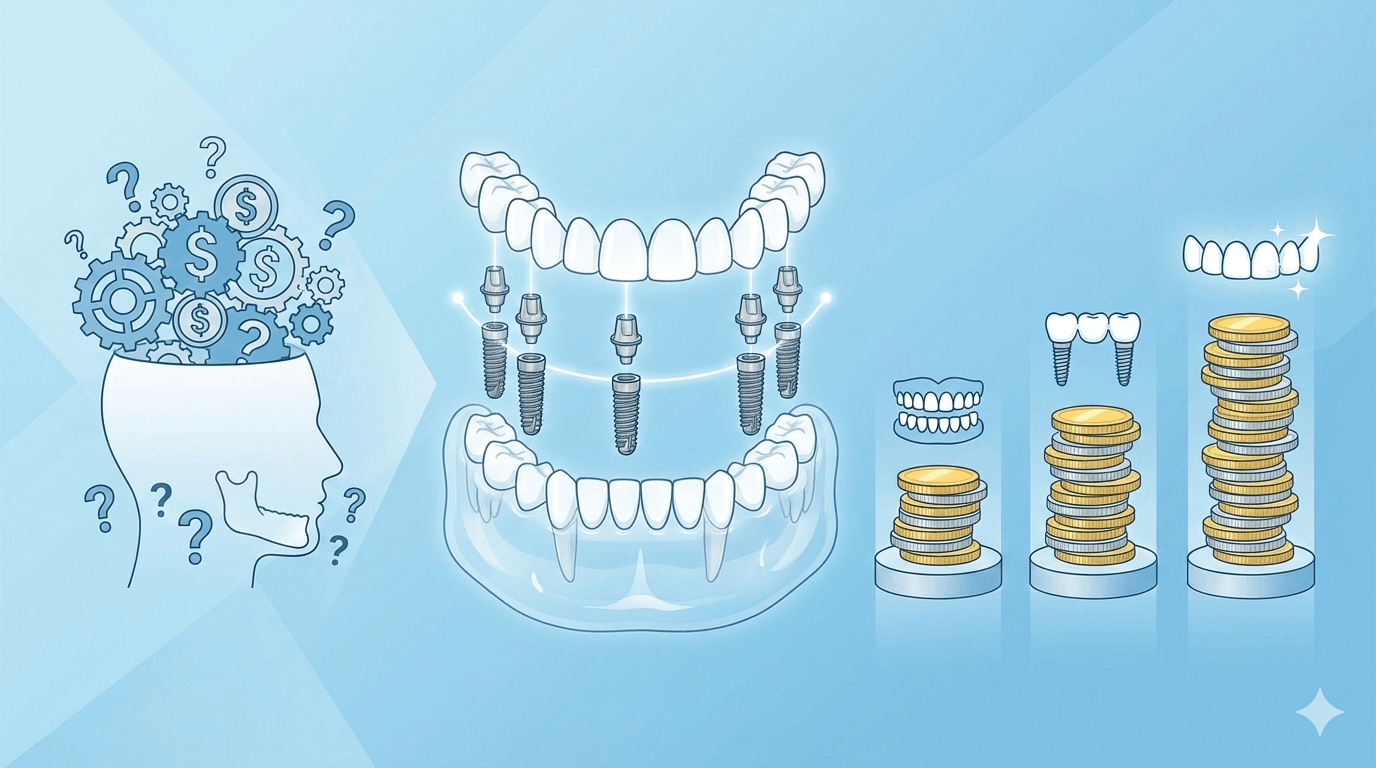
If you have started researching how much does a full set of dental implants cost, you have likely realized that finding a straight answer is like trying to pin down a moving target. You see advertisements for "cheap" implants that sound like a bargain, only to walk into a consultation and be handed a treatment plan that rivals the price of a mid-sized SUV.
For the average American patient aged 45 to 65, the sticker shock is often the biggest barrier to care. You are not just buying a dental procedure; you are making a major financial decision for your long-term health. According to industry data and financial benchmarks, a full-mouth restoration in the U.S. typically sits between $30,000 and $60,000 per arch.
But here is the insider reality: the "average" price is rarely what you actually pay. Between insurance limitations, hidden surgical fees, and the critical role of financing, the final number on your bill depends entirely on how you navigate the system. As an advocate, my goal is to help you move past the marketing fluff and understand the clinical and financial variables that determine your final investment.
To understand how much does a full set of dental implants cost, we have to deconstruct the "all-in" quote. A "full set" usually refers to a fixed bridge supported by four to six implants (commonly called All-on-4 or All-on-6). You aren't paying for 32 individual screws; you are paying for a complex engineering project in your jaw.
Based on clinical standards and cost data provided by authorities like CareCredit, the total cost is a sum of several "unbundled" services that clinics often hide until the final contract.
Before the first implant is even placed, you may incur costs for:
You are paying for the "post" (the screw), the "abutment" (the connector), and the "prosthesis" (the teeth). Premium manufacturers like Straumann or Nobel Biocare invest heavily in clinical research, which is why their hardware costs significantly more than "generic" private-label implants.
For a full-arch procedure, most patients prefer IV sedation or general anesthesia. This isn't usually included in the "base" price and can add $500 to $2,000 to the total bill, depending on the length of the surgery.
Pro Tip: When comparing quotes, always ask if the price is "Restored." Some clinics quote the "Surgical Phase" only (the screws), leaving you to discover later that the actual teeth cost an additional $15,000.
One of the biggest misconceptions in modern dentistry is that dental insurance will cover the cost of a full set of implants. In reality, most dental PPO plans have an annual maximum of $1,500–$2,000. While insurance might cover the crown (the tooth) or the extraction, it rarely covers the implant post or the surgical labor.
This is where financing becomes a critical part of the conversation. According to clinical data and financial providers, most patients bridge the gap between their insurance "coupon" and the total cost using a combination of methods:
Pro Tip: Many premium dental offices offer a "Cash Discount" (usually 5–7%) if you pay the full amount upfront. If you are using a personal loan or savings, always ask for the "Pre-pay discount" to shave thousands off the total.
The goal of your research shouldn't be to find the lowest price—it should be to find the lowest risk. However, there are legitimate ways to lower the price without compromising your safety.
In the U.S., dental pricing is heavily influenced by zip code. A specialist in Beverly Hills or Manhattan has overhead costs that a board-certified surgeon in Dallas or Salt Lake City does not. It is common for patients to save $15,000 by flying to a "High-Volume Implant Center" in a lower-cost state. These centers specialize exclusively in full-arch cases, meaning they buy hardware in bulk and pass those savings to you.
It sounds counterintuitive, but seeing a specialist (Oral Surgeon or Periodontist) often saves you money in the long run. According to the American Association of Oral and Maxillofacial Surgeons (AAOMS), specialists are better equipped to handle bone grafting and sinus issues. A "cheap" implant placed by an inexperienced generalist that fails after two years will cost you double to fix.
Avoid clinics that bill "unbundled" services. Look for centers that offer a single, all-inclusive price that covers everything from the initial 3D scan to the final Zirconia bridge. This protects you from "cost creep" during the healing phase.
When evaluating how much does a full set of dental implants cost, remember that the highest cost is the surgery you have to do twice.
Informed patients win because they understand that value isn't just a number it’s the intersection of surgical skill, material quality, and a payment plan that doesn't compromise their financial future. By leveraging domestic arbitrage, maximizing pre-tax accounts, and utilizing specialized financing, you can access the gold standard of dental care without the "Coastal Premium."
Don’t guess with your health or your wallet.
Our Dental Implant Cost Evaluation compares local US pricing, state-to-state savings, and vetted international options - customized to your mouth and your goals.
Get your personalized report today.